Jakarta, 10 June 2026 – The Danantara Monitor Coalition noted the importance of transparency in the management of state assets and finances by Danantara Sovereign Wealth Fund to prevent dual fiscal pressure in the midst of rupiah exchange rate volatility and rising global oil prices. Transparency is needed so that the public can oversee the management of the 300 trillion rupiah in assets by Danantara and ensure that the projects it finances benefit the public.
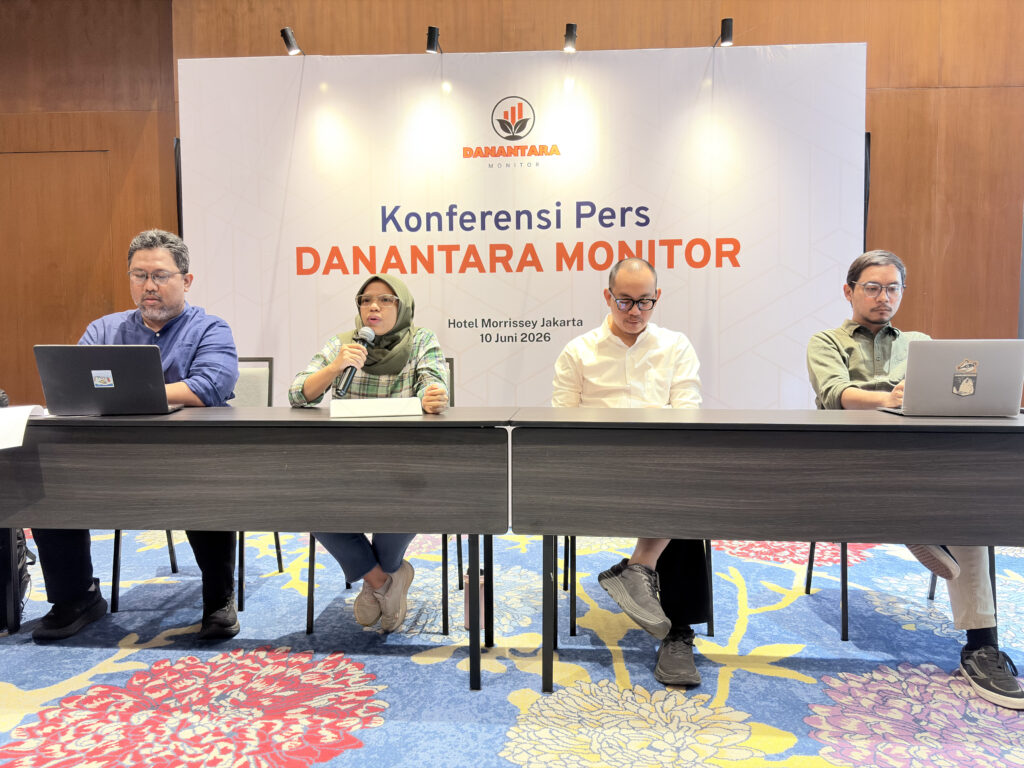
At a press conference held on Wednesday (10/6) in Jakarta, the Danantara Monitor Coalition stressed that the public has the right to know how the state funds and assets managed by Danantara are used, which projects are being financed, and to what extent these investments provide benefits to society and protect the environment.
Bhima Yudhistira Adhinegara, the executive director of the Center of Economic and Law Studies (CELIOS), said that Danantara’s governance and transparency are inferior to its predecessor, the Indonesia Investment Authority (INA). Danantara is not yet registered with the International Forum of Sovereign Wealth Funds (IFSWF) and has not adopted the Santiago Principles as a global transparency reference.
“Danantara has not implemented financial transparency, raising serious questions about the accountability standards it applies,” Bhima said. “If this is not immediately addressed, Danantara risks creating double fiscal exposure, whereby SOE dividends that previously went to the state budget (APBN) are now managed by Danantara, while at the same time this institution can still receive funding support from the state budget. As a result, the state’s financial exposure to Danantara’s performance becomes larger from two directions at once.”
Bhima also highlighted the lack of clarity between claims and the realization of investments under Danantara. The institution has announced various memoranda of understanding (MoUs) with massive values, but these have not been accompanied by concrete, sustainable projects with tangible impacts on the economy. In addition, there is no list of priority investments that the public can use as a reference to assess its commitment to sustainable development and job creation.
TrendAsia Campaigner Novita Indri hopes that Danantara will not only prioritize investments in so‑called priority projects but also in sustainable projects. In reality, most of the 18 projects that the government has mandated to Danantara still favor businesses related to fossil fuels.
“From that list of projects, Danantara is actually not being prioritized to finance clean projects. Meanwhile, Indonesia has recently been hit by climate disasters, with the looming El Niño Godzilla right before our eyes. Yet many global SWFs are now diversifying their investments into clean energy and renewable energy,” Novita said.
Novita also underscored Danantara’s support for waste‑to‑energy power plant (PLTSa) projects. Experience over the past few years has shown that many PLTSa projects in Indonesia face serious obstacles – ranging from technical problems and the readiness of waste management systems to project economic viability – which can potentially harm public finances.
Head of the Advocacy Division of Indonesia Corruption Watch (ICW) Egi Primayogha stated that there is potential or room for corruption if there is no transparency in the management of state assets and finances amounting to 300 trillion rupiah by Danantara, because the public will find it difficult to monitor this institution. In addition, Danantara also risks becoming immune from the law because it is reinforced by Law No. 16 of 2025. Beyond the issue of transparency, Danantara is also at risk of becoming an instrument for consolidating the interests of economic and political elites, particularly those affiliated with the extractive sector.
“Up to now, the public still does not have clear access to the financial statements or detailed information about how the funds managed by this institution are used. This situation is contradictory to the narrative of budget efficiency that the government continues to push, while at the same time the state allocates very large resources to a new institution whose accountability mechanisms remain vague. Now that Danantara oversees various strategic SOEs, it is reasonable to worry that the various governance problems and alleged corruption within SOEs will not receive proportional oversight, even though over the last decade the SOE sector has been marred by hundreds of corruption cases,” Egi explained.
The Danantara Monitor Coalition has formally submitted information requests to BPI Danantara and the Audit Board of Indonesia (BPK) on Wednesday, 3 June 2026. In response to these demands, Danantara has promised to disclose its financial statements at the end of June. The Danantara Monitor Coalition will follow up this request with the Information Commission.
The Danantara Monitor Coalition will next highlight the implications of Danantara’s performance for labor and food. The Coalition will continue to promote transparent and accountable governance practices and will monitor this information disclosure process as part of efforts to strengthen public oversight of state wealth management.
***
Media Contact
Danantara Monitor Coalition
Email: [email protected]
About Danantara Monitor
Danantara Monitor is a civil society coalition that monitors the governance, transparency, accountability, and the economic, social, and environmental impacts of asset management and investments under Danantara. The coalition aims to ensure that state wealth is managed in an open, responsible manner that serves the public interest. The coalition consists of the Center of Economic and Law Studies (CELIOS), Indonesia Corruption Watch (ICW), Yayasan Indonesia Cerah, Climate Rangers, Enter Nusantara, and Trend Asia.