
Published on September 23, 2025, by MUI.or.id
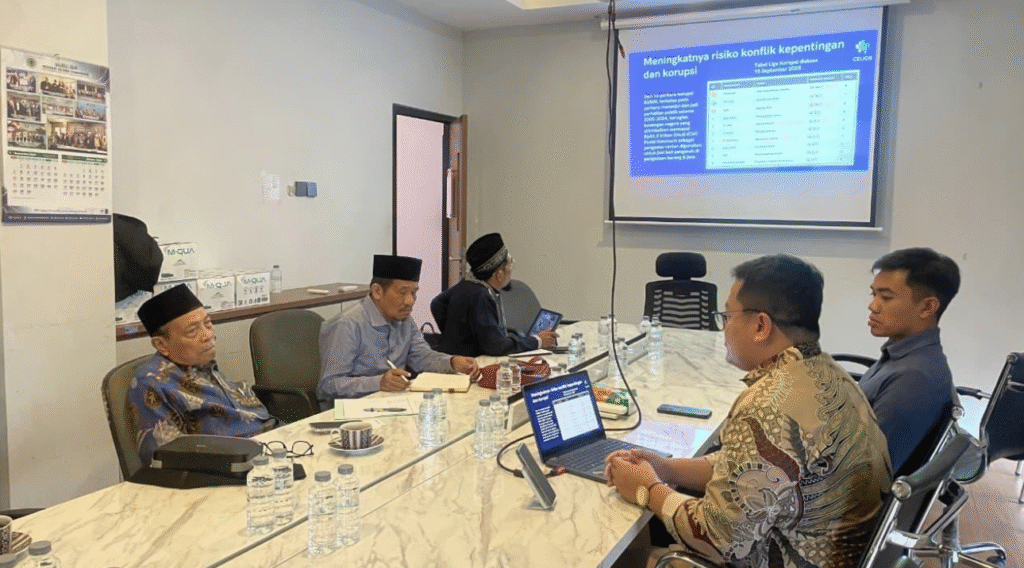
JAKARTA, MUI.OR.ID — The Indonesian Ulema Council’s (MUI) Fatwa Commission received a visit from the Center of Economic and Law Studies (Celios) to discuss a request for a fatwa on the salaries of ministers and deputy ministers holding concurrent positions as commissioners at state-owned enterprises (SOEs). The meeting took place at MUI office on Thursday (18/9).
Deputy Chairman of MUI Fatwa Comission Prof. Amin Suma said the meeting was a follow-up on Celios’ fatwa request by inviting Celios, the mustafti or the party who asks for a fatwa, to provide a deeper explanation.
Prof Amin Suma, a professor at UIN Syarif Hidayatullah, said fatwa discussion and determination process must begin with a complete understanding of the request’s substance.
“The MUI Fatwa Commission welcomed Celios as a follow-up to its request for a fatwa concerning the salaries of ministers and deputy ministers who also serve as commissioners in state-owned enterprises. We are seeking clarification about the substance and scope of this request,” Prof. Amin Suma told MUI Digital in Jakarta on Tuesday (23/9).
Prof. Amin Suma said the meeting between MUI Fatwa Commission and Celios was held cordially. During the discussion, Celios explained that its request for a fatwa was part of a public responsibility to ensure that state officials comply with existing laws and regulations.
Celios noted that the Constitional Court, in its ruling number 128/PUU-XXIII/2025, had explicitly prohibited ministers and deputy ministers from holding concurrent posts as commissioners in state-owned enterprises.
However, to date, the government has not enforced the ruling and no ministers or deputy ministers have resigned from such commissioner positions.
“Until now, this prohibition has not been observed. That is why Celios has come forward to provide encouragement, as well as ethical and religious perspectives, as part of the efforts to find a solution,” Prof. Amin said.
Prof. Amin emphasized that the Fatwa Commission essentially receives and listens to such requests as part of tashawwur or a process of thoroughly examining an issue before issuing a religious opinion.
In a letter numbered 72/CELIOS/IX/2025 addressed to MUI Fatwa Commission, Celios submitted three questions.
First, what is the legal basis for the income received by ministers and deputy ministers from their concurrent positions, given that the Constitutional Court has legally prohibited this?
Second, is the income considered halal, syubhat, or haram according to Islamic law?
Third, how should Muslims, particularly state officials, respond to this issue in order to remain aligned with the principles of justice, trustworthiness, and transparency in managing state finances?
The meeting was attended by Deputy Secretary of the Fatwa Commission KH Arwani Faishol, KH Sulhan, and KH Zafrullah Salim, as well as Celios representatives Galau D. Muhammad, Media Askar, and Nailul Huda.